what did the nazis used to glorify their goals
"Divine destiny has given the German language people everything in the person of one human being. Non only does he possess strong and ingenious statesmanship, non only is he ingenious as a soldier, not just is he the commencement worker and the get-go economist among his people but, and this is perhaps his greatest forcefulness, he is an artist. He came from art, he devoted himself to art, especially the fine art of architecture, this powerful creator of peachy buildings. And at present he has too go the Reich'due south builder."
--Hakenkreuzbanner (The Swastika Flag), June ten, 1938
Art was considered to be i of the most important elements to strengthening the Third Reich and purifying the nation. Political aims and artistic expression became ane. The task of art in the 3rd Reich was to shape the population'south attitudes by carrying political messages with stereotyped concepts and art forms.
True art as defined by Hitler was linked with the country life, with health, and with the Aryan race. "Nosotros shall discover and encourage the artists who are able to impress upon the State of the German people the cultural postage of the Germanic race . . . in their origin and in the picture which they present they are the expressions of the soul and the ideals of the community." (Hitler, Party Day speech communication, 1935; in Adam, 1992)
Mod art had no place in the Third Reich.
Instead, the function of the artists was to either portray the German world every bit peaceful, or as drawn into a struggle for survival to defend information technology. Thus, art was to become one more weapon in the Nazi regime's arsenal. Hitler was a master manipulator, and understood the value of propaganda and artistic fervor. He also understood how to control people by threatening their chore, family and existence. Artists who did not autumn in with the party ideal risked their life. The artists glorified the German citizens, soldiers, and Hitler's ethics. The painters used their art to depict Hitler as the healing element that would cure the country's ills. They too painted the mutual "Volk" (folk) in everyday settings. The fine art of this racially pure state was to overcome differences in class and mold all of the people into one platonic. When not painting pastoral scenes or glorifying the war, the artists would plough their paint brushes against the Jew, depicting him as inhuman and junior. Examples of artwork approved by the Third Reich can be plant on the following Websites.
 Examples of Nationalsocialist Realism from the Virtual Museum of Political Art.
Ernst Vollbehr, Reichsparteitag in Nürnberg (NSDAP political party convention in Nuremberg), 1933.
Examples of Nazi art including 4 sculptures by Arno Breker (The Guard, The Warrior Departs, The Party and The Army, Preparedness), Adolph Wissel'south Farm Family unit from Kahlenberg, Hubert Lanzinger's The Flag Bearer, Albert Janesh 's Water Sports, and Ernst Liebermann's Past the Water.
Architecture was Hitler's favorite art form. He viewed himself equally the "chief builder of the Third Reich." Among the surviving examples of Nazi architecture is the Olympic stadium complex in Berlin.
The Olympic games had been scheduled before Hitler came to power in 1933. He saw this upshot as a unique opportunity to play host to the world and to evidence Germany as a force to be reckoned with. He wanted Frg to be portrayed in the best possible light and removed all antisemitic slogans that had defaced the walls of public buildings. The stadium was built equally a huge assembly place for hundreds of thousands of people to celebrate Nazi rituals. The art that accompanied this colossal building was no less magnificent.
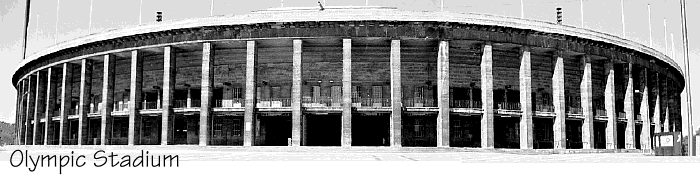
 Photographs of the stadium built for the 1936 Berlin Olympics.
More information on the Olympic Stadium.
This short biography of Albert Speer, Hitler's architect, includes a page of photographs of Speer and a few of his projects.
Read an English translation of Albert Speer'southward The Fürhrer's Buildings.
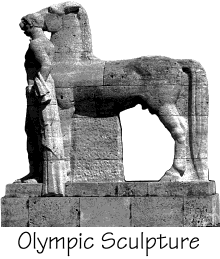 Photographs of sculptures on the grounds of the 1936 Berlin Olympics site.
Josef Thorak was i of ii official artists for the Third Reich. He was given a huge studio near Munich in 1938. It was here that he worked on his big pieces, some as alpine as sixty-v feet. His horses were destined to be placed at the Nuremberg Stadium. Other sculptures include his huge Monument to Work, and The Judgment of Paris. Merely Hitler was a fickle fan, and his regard for Thorak faded. Breker became the more favored artist.
Biography and samples of Thorak's work.
Arno Breker learned to sculpt in the studio of his father, a bricklayer and sculptor. He studied at the Dusseldorf Academy, so went to Rome, where he worked on the restoration of Michelangelo's Rondanini Pieta. It was in that location he met Goebbels for the beginning time. He was nominated as official state sculptor on Hitler'south birthday in 1937. Hitler considered Breker's The Regular army and The Political party as the most beautiful work ever fabricated in Frg.
For a more detailed biography of Breker.
George Kolbe was fifty-half-dozen when Hitler came to power, an established artist in his ain right. Although at the outset he was attacked equally sympathetic to the Jews considering he had done monuments to the Jewish poet Heinrich Heine, his piece of work was of such quality that he was forgiven this transgression. Kolbe would never become an official creative person of the Third Reich; his art was also private, and not on a large enough calibration to suit Hitler'due south taste.
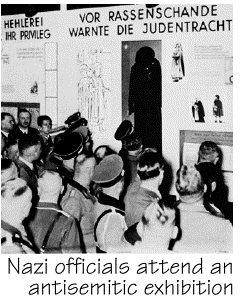 Hitler understood the power of propaganda. In his book, Mein Kampf, Hitler wrote 2 chapters on propaganda, stating that is must be aimed at people's emotions rather than their intellect. Posters of Hitler filled Nazi Germany, depicting him as a kind, gentle leader who possessed immense forcefulness and a passion for art and culture.
Propaganda was also used to denigrate and defame the Jews. Julius Streicher'due south newspaper, Der Stürmer, featured crude caricatures defaming the Jewish people. Even children'south textbooks were enlisted in the Nazi campaign of hatred.
 Four examples of Nazi antisemitic propaganda.
Political cartoons from Der Stürmer.
A reproduction of the antisemitic children's volume, Der Giftpilz (The Poisonous Mushroom).
Political cartoons from Brennessel, a Nazi humor mag.
German political cartoons from late 1939 on the theme that an innocent Frg has been forced into state of war.
Nazi political posters.
View a large collection of German propaganda posters.
Film making was also pressed into the service of the Nazi propaganda motorcar. Hitler's favorite director, Leni Riefenstahl, produced The Triumph of the Will glorifying the 1934 Nazi political party congress at Nuremberg. No expense or effort was spared in the production of this film; holes were dug into the footing to let for the best photographic camera angles and Party officials were kept waiting for hours as the firming progressed. Another Riefenstahl picture, Olympia, glorified the Aryan racial type in the context of the Olympics. The film reinforced the Aryan/ Olympic myth by superimposing High german athletes over classical Hellenistic sculpture.
Nazi filmmakers besides turned their cameras on their victims, methodically reducing the popular perception of Jews to that of vermin, fit only for extermination. The Nazi propaganda picture show, Der ewige Jude (The Eternal Jew), followed maps showing the migrations of Jews with scenes of teaming rats. The motion-picture show'southward narration drives domicile the clan:
[The Jews] followed the civilisation-bearing and artistic waves of German language colonization of the Eastward, until finally they found a gigantic new untapped reservoir of infinite in Poland and Eastern Europe . . . they spread from Eastern Europe like an irresistible tide, flooding the towns and nations. . . . Wherever rats announced they bring ruin, past destroying mankind's appurtenances and foodstuffs. They are cunning, cowardly, and cruel, and are found mostly in large packs. Among the animals, they represent the rudiment of an insidious and underground destruction--merely similar the Jews among human beings.
Lxxx-three nonetheless images from the Nazi propaganda film, Der ewige Jude.
Article on Nazi antisemitic films from the Encyclopedia of the Holocaust.


A Instructor's Guide to the Holocaust
Produced by the Florida Center for Instructional Technology,
College of Education, University of S Florida © 1997-2013.
Source: https://fcit.usf.edu/holocaust/arts/artreich.htm

Mag-post ng isang Komento for "what did the nazis used to glorify their goals"